
DZHUS: Transformation as Survival
There is a tension at the core of Irina Dzhus’ work, between control and unraveling, precision and emotion. Through DZHUS, she creates garments that shift and transform, resisting fixed forms and inviting multiplicity. What appears structured is never static; what feels complete is always open to change. In this space, clothing becomes more than function, it becomes a reflection of inner states, of movement, of survival. Her work does not seek resolution. It holds space for contradiction.
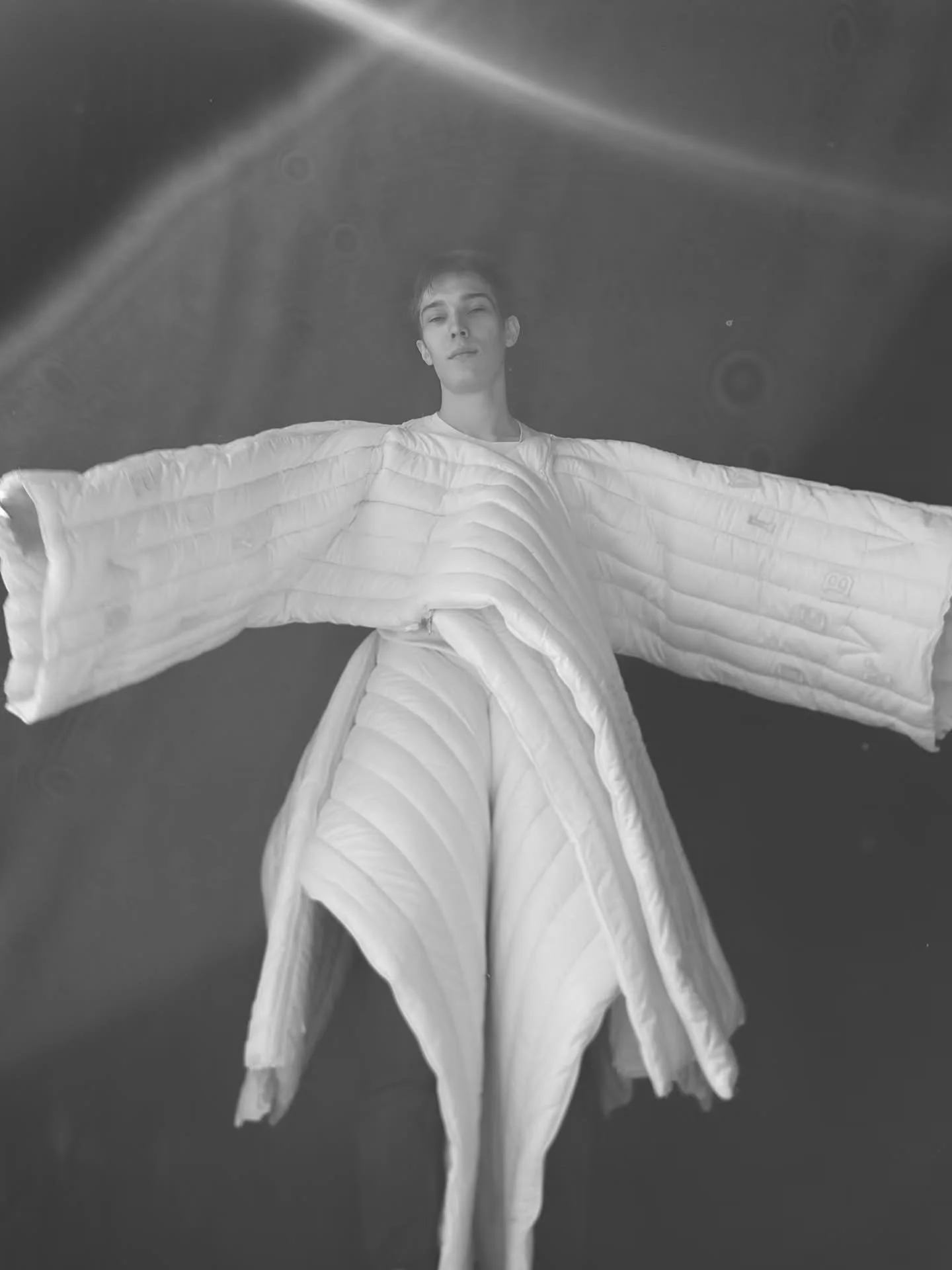
Tallinn ANTICON fitting archive. Courtesy of artist.
We The Cool:How would you describe yourself, both as a person and as a designer?
Irina Dzhus: A neuroatypical nonconformist, driven with imprinted determination, for the sake of a mission accomplishment, alongside a humble hope for a personal miracle.
WTC: How was DZHUS born?
ID: The legend goes like this: I had intended to become a mermaid until family members discouraged me from the uncertain occupation. As a compromise, still involving my interests, I took a decision to go for fashion design. I was 5. At 14, as a children’s art school student, I managed to reach my then favourite Ukrainian designer who gently became my tutor. On my 1st uni year, I realised the education was hopelessly outdated and completed an internship at her fashion house. This practice has provided me with immense knowledge and priceless experience, shaping the foundation for DZHUS’ future aesthetics. Along with my graduation in 2010, my eponymous label was launched in my hometown, Kyiv.
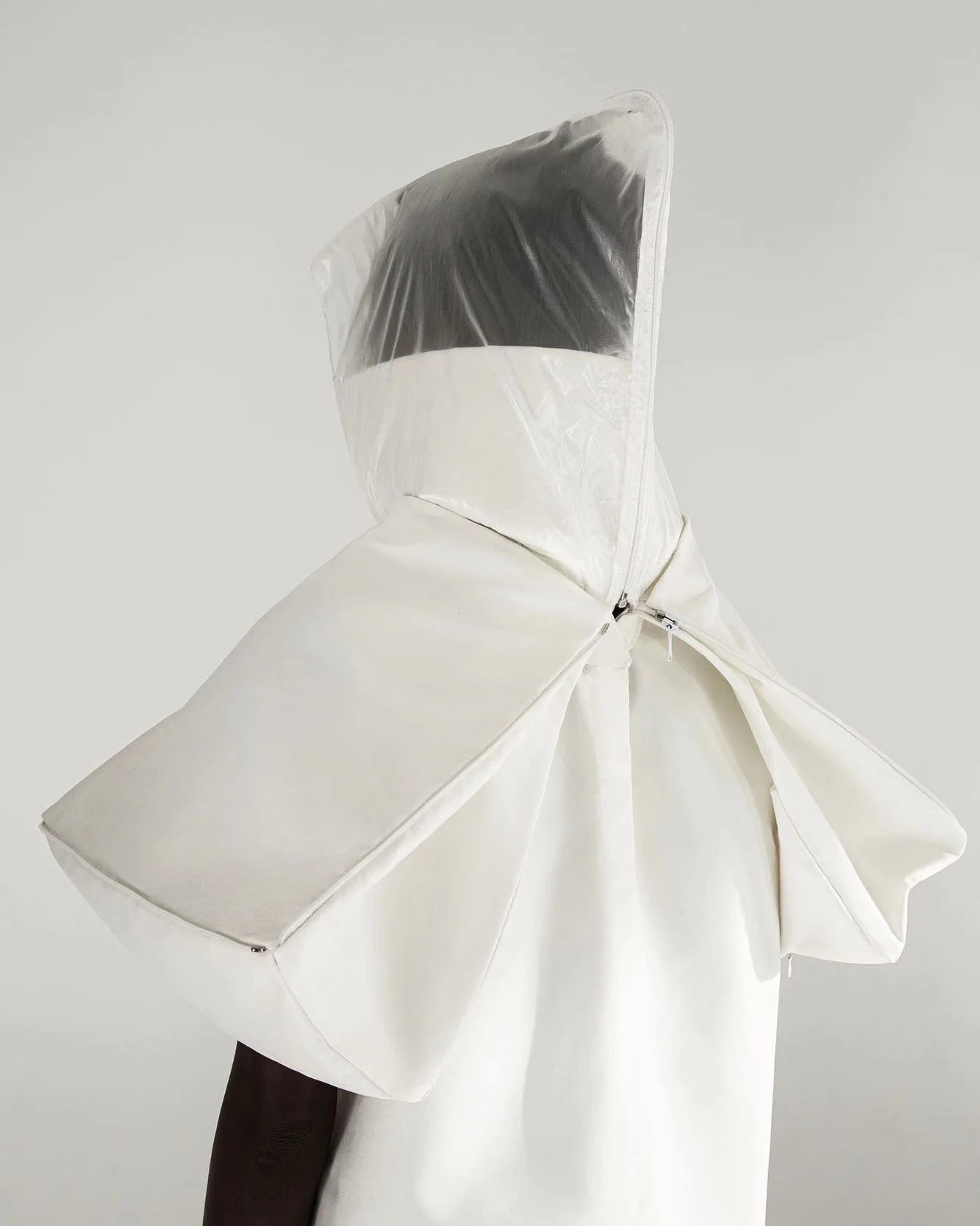
ID 3-way transforming dress. Courtesy of artist.
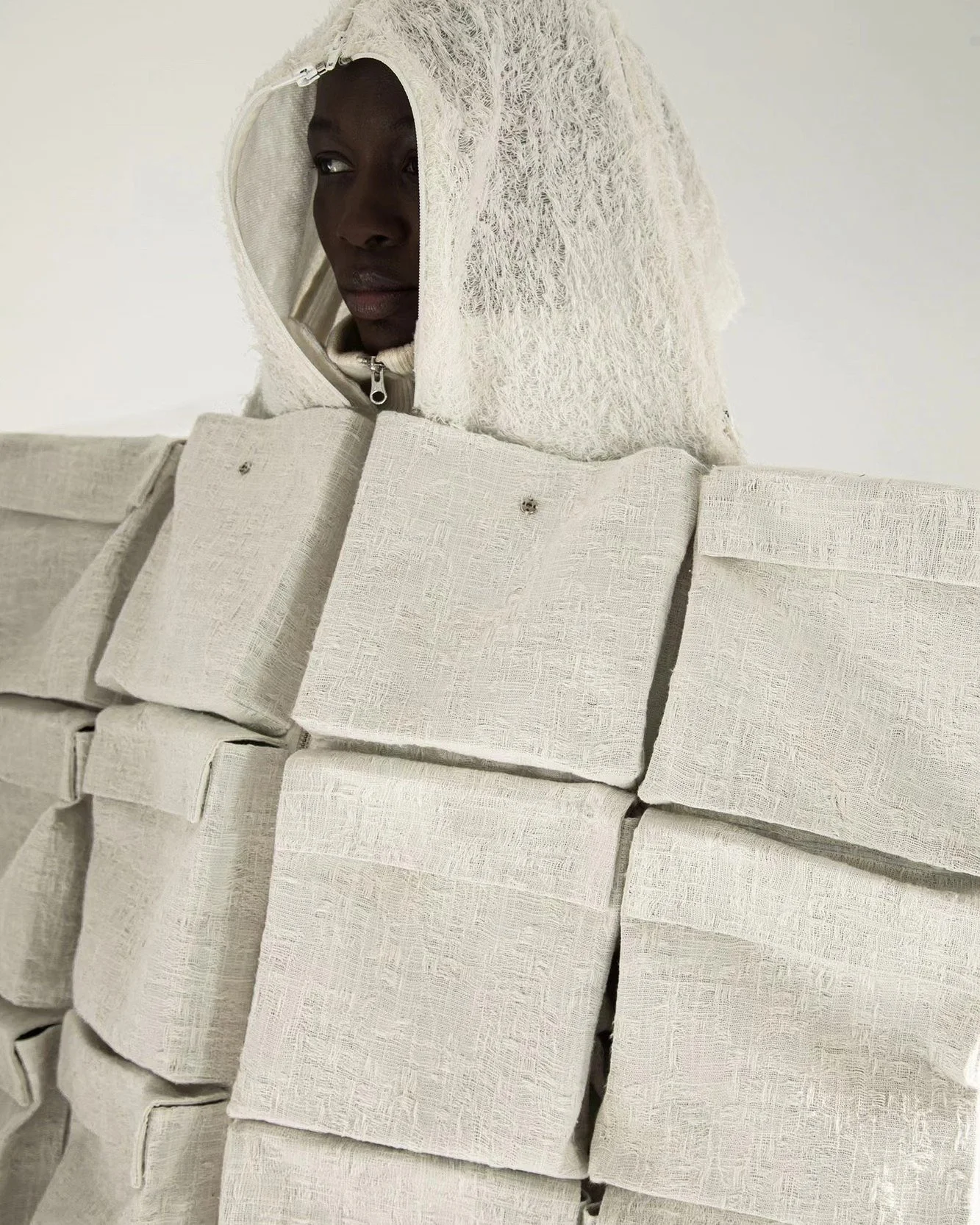
TRANSIT 3-way transforming piece: jumpsuit / coat. Courtesy of artist.
WTC: Originally from Ukraine, you now work between Warsaw, Berlin, and Paris. When did you leave Ukraine, and what led you to build your life and creative practice across these three cities?
ID: As the war began, I fled Ukraine within the mass evacuation movement on the first days of the invasion. I found my refuge in the EU, reestablishing the brand and reinventing my new reality. I was shortly invited to participate in Fashion Weeks worldwide and teach at European design schools. With its already notable international background, from Parisian wholesale showrooms to a global clientele, DZHUS has obtained a new level of recognition and involvement soon after its HQ’s relocation. Today, I mainly reside in Poland, while engaged in permanent activity in Germany, with frequent projects in France, Italy, Belgium, Austria, Central Europe, and the Baltics.
WTC: How does your Ukrainian identity shape your creative language today given the current context?
ID: The war has imposed a representation superstructure on every Ukrainian creative. Cultural diplomacy has now become our mission, regardless of the individual artistic vector. Our DNA has embraced the cultural code, and every public occasion has since served as a chance to shout out, drawing the global focus to the wartime paradigm, via the insider perspective. I’m no exception, integrating in the new dimension in both the supporter and supportee hypostases. DZHUS’ relocation began with charity pop-ups around Europe, continued with a powerful Berlin Fashion Week debut, reflecting on the shared evacuation experience through thought-provoking metaphors, and has, by now, obtained an impactful voice, addressed both inside the global migrant community and towards the global audience. Today, it’s no longer enough to ‘celebrate the Ukrainian culture’ with direct references, since it’s not questioned anymore, having conquered a firm niche on the global scale. A Ukrainian artist is now expected to stand out with an authentic, individualised message, translating their unique background through a multilayered, metamodernist visual product.
WTC: What originally led you to see clothing as something mutable rather than fixed?
ID: Innovation lays at the core of the DZHUS identity. In practice, I filter out all the unoriginal solutions at the conceptualising stage of my design process. Considering the nowadays’ environmental tragedy, to which the fashion industry contributes generously, I only find new solutions reasonable and worth release. Since even those don’t justify another production cycle, ‘sustainable fashion’ is an oxymoron. With my pattern-making inventions, I aim at suggesting an inspiring and encouraging alternative to radical limitations many eco approaches impose, making the practice too frustrating to go for. Transformer clothing are playful, therapeutical, unprecedentedly adaptable, and a revelation when it comes to conscious wardrobe or travels. What started as an intellectual quiz amongst my avant-garde construction challenges, at the dawn of my professional establishment, has developed into a manifestation of smart and ethical design.
Besides, my collections are extremely personal, transmitting intimate reflections through eloquent symbolism. Thus, transformation stands for fluidity of a condition, both mental and physical, under the impact of circumstances and insight.
WTC: You often describe your process as “patterns into patterns.” What does this phrase mean to you on a personal and conceptual level?
ID: As an OCD individual, I live an exaggeratedly structured life, shaped by patterns and practical rituals. The private situation I hadn’t coped with has laid a devastating imprint on my entire self-identification and incarnated in another, yet unprecedentedly dominating, obsessions-compulsions cycle. I would want to present my consequent 3 cathartic collections as an effective coping strategy, but that’d be a hypocrisy, betraying fellow grieving individuals. The truth is I was forced to create the collections, having won one prestigious grant after another, all funding creation of new projects, and none supporting a human in a critical condition until they recover enough to return to activity. Since I no longer was (and still am not) capable of working in a ‘normal’ way, the only solution to physically maintain and pay the inevitable bills has been nonstop engagement in creative projects utilising the modest artist rewards or budget leftovers where the terms allowed.
If my mental state could become even worse, this vicious circle has doomed it. Eventually, I had to make a tough decision, coping with poverty as a state of being and non-creation as a declaration of unconditional acceptance of my destiny, for the sake of vague hope for eventual wellbeing. Returning to the ‘patterns into patterns’ concept, regardless of my private outcome, embodying the trauma into a design product not only resulted in eloquent wearable art pieces, but also came out as a social impact tool, enabling people who experience their own inner struggle to come out and let chances in.
WTC: Having been recognized by platforms like the International Woolmark Prize and major global media, how do you define success today?
ID: I question the very notion of success, learning to approach it stigma-free. In a nutshell, I am no adept of today’s civilisation agenda presenting success as a default value. Focusing on an introspective interpretation of success: as something an individual aspires for on their subjective way to fullfilment and wellbeing, I envision my own triumph point on the intersection of the destination completion and private happiness. Whilst the brand has been, slowly by slowly, developing throughout its almost 16-year history, I am, myself, only beginning to define my sacred path. Having faced a personal tragedy, followed with overwhelming grief and years-lasting agony that mutates instead of seizing, I found myself in a permanent rediscovery mode, with the highest priority for progress in my personal story and no more room for social expectations.
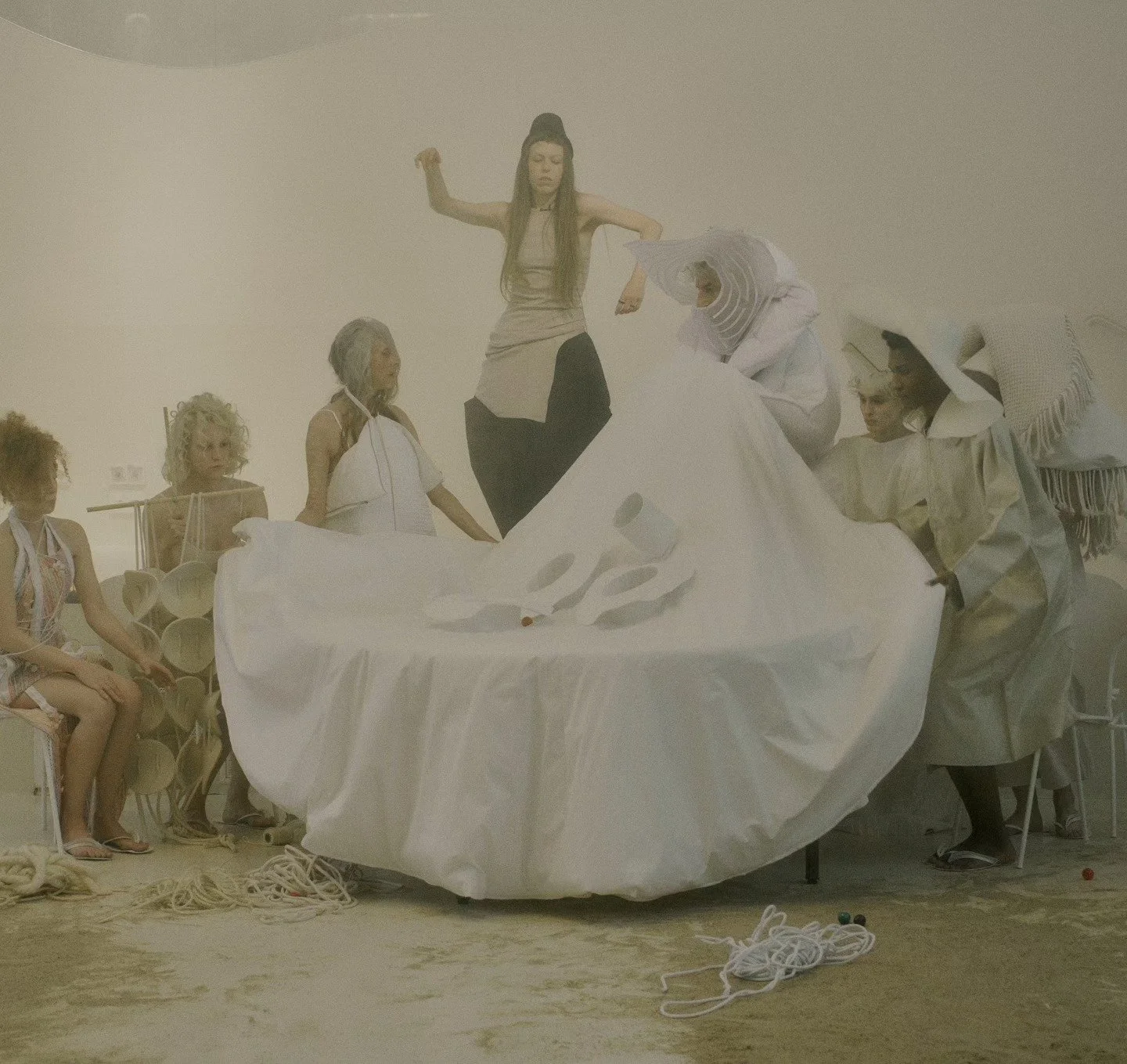
ZHUS SS25 "ANTICON" show at @berlinfashionwe. Photography by @wangdahow.
WTC: Does international visibility change how you communicate your ethical and conceptual values?
ID: I do pragmatically utilise DZHUS’ recognition to popularise conscious approach to wardrobe, propagate the cruelty-free life paradigm, and impose humanism as a civilisational essential, contraposed to the war atrocity. Having said that, I am, by no means, cynical or arrogant in my perception of DZHUS’ audience but on the contrary: I couldn’t have been more grateful to my stunning soulmates constellation worldwide for their priceless trust and loyalty.
WTC: I love that 30% of profit supports animals, tell us more about this. Why this cause?
ID: As a child, I was ruined by witnessing violence towards animals, alongside being abused myself. Naturally, I have developed no empathy, with an exception for animals and kids (in such order, according to the measure of harm). My desperate desire to facilitate suffering or the most vulnerable will never seize, whereas my compassion to adults won’t exceed the cognitive level. In the wartime reality, it is, at least, obvious that minor’s welfare must be taken care of, first and foremost, and there are major initiatives patronising or raising funds for children’s rehabilitation. In the face of the humanitarian tragedy, the level of natural disaster, caused by the invasion, is less vivid, underestimated, and unprioritised. As a fragile business and a broken outsider in the personal dimension, I couldn’t relate more and consider my duty to redirect tiny amounts, yet a significant part of my profit, into budgets of fellow struggling entities who have more determination than I to help abandoned or injured animals via practical actions.
WTC: How do you imagine the future of multi-purpose clothing in a world facing environmental and social instability?
ID: In the face of the urgency, I prioritise a live mode over futurology. Multifunctional garments can reinvent shopping today, shifting the focus from quantity to a correlation within the universal wardrobe capsule, coordinated from few transformable pieces. Outfit co-creation involves the customer into a conscious approach to styling, as a self-definition tool, accompanied by an auto-therapeutical practice, increasing emotional welfare. DZHUS designs neutralise the toxic influencer trend for non-repetitive looks, offering multiple, radical metamorphosis within each item, whereas combos allow for experimentation beyond borders. Besides, I confront the packaging waste issue with a reusable tote, transformable into a wearable top, that comes complimentary with every retail order.
WTC: For your brand DZHUS, what are the non-negotiable fundamentals? Are there core principles—whether conceptual, ethical, or technical—that remain constant regardless of season or collection?
ID: To be labelled ‘DZHUS’, a product must be cruelty-free and feature either alternative or innovative pattern-making (don’t confuse for complex cut for the sake of aesthetics), or a revolutionary perspective on a function. Thought-provoking narratives and multidisciplinary presentation also seem inevitable from the brand’s DNA, nevertheless, I do envision room for commercial or technological collabs with less focus on the declarative component, provided that they go in line with DZHUS’ and my personal moral values.
WTC: This edition is titled “Back to Basics.” When you hear this phrase, what does it evoke for you? Beyond trends or aesthetics, what does “back to basics” mean to you as a personal philosophy or life position?
ID: The statement fully resonates with me, on an intimate level. Having undergone a major personality deconstruction, I got familiarised with the in-between state, charming in its purist, fearless and stereotype-free energy.
“For me ‘back to basics’ means a blind rendezvous with the primordial, the essential, and the luxurious choice: what to layer on top, if anything.”
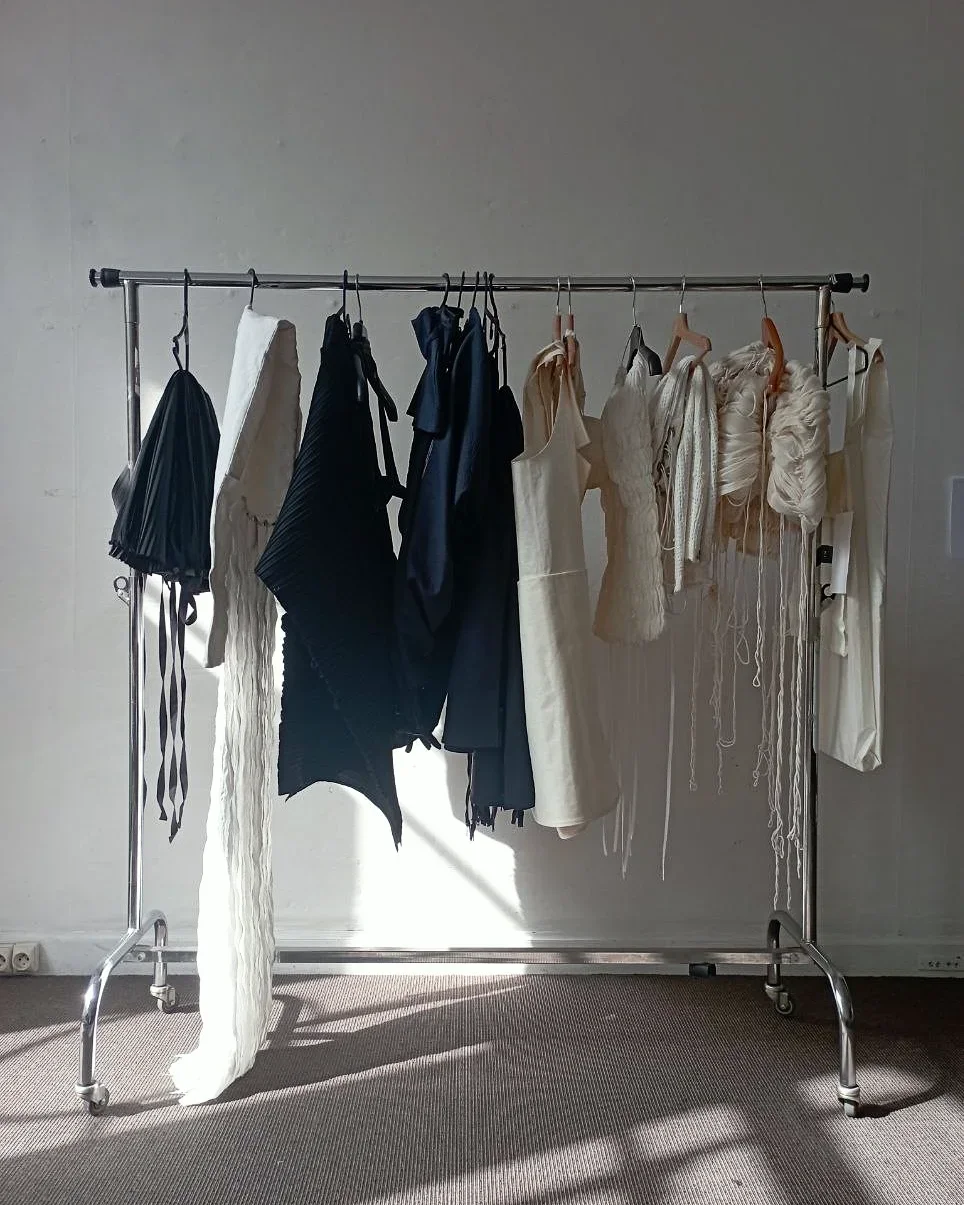
DZHUS SS24 one-day showroom and presentation during Paris Fashion Week. Courtesy of artist.